In this article
The short version: Anthropic’s Frontier Red Team says an unreleased internal research model found bugs in Chrome, Safari, Android, Windows and Linux and wrote five working exploit chains. Anthropic built these exploits in its lab. It says it reported every bug to the vendor, and every one is now patched. Neither CVE named in the post is in CISA’s Known Exploited Vulnerabilities catalog, Microsoft lists CVE-2026-33096 as not exploited, and we found no report of any of the five being used in attacks. The one that needs your attention is Linux: if you run Linux servers, make sure the kernel includes the fix for CVE-2026-98432.
What happened
On October 27, 2026, Anthropic published “Discovering and exploiting vulnerabilities in critical, real-world software with Claude.” The post says that “after initial prompting,” the model wrote five exploit chains with “little to no user interaction” needed:
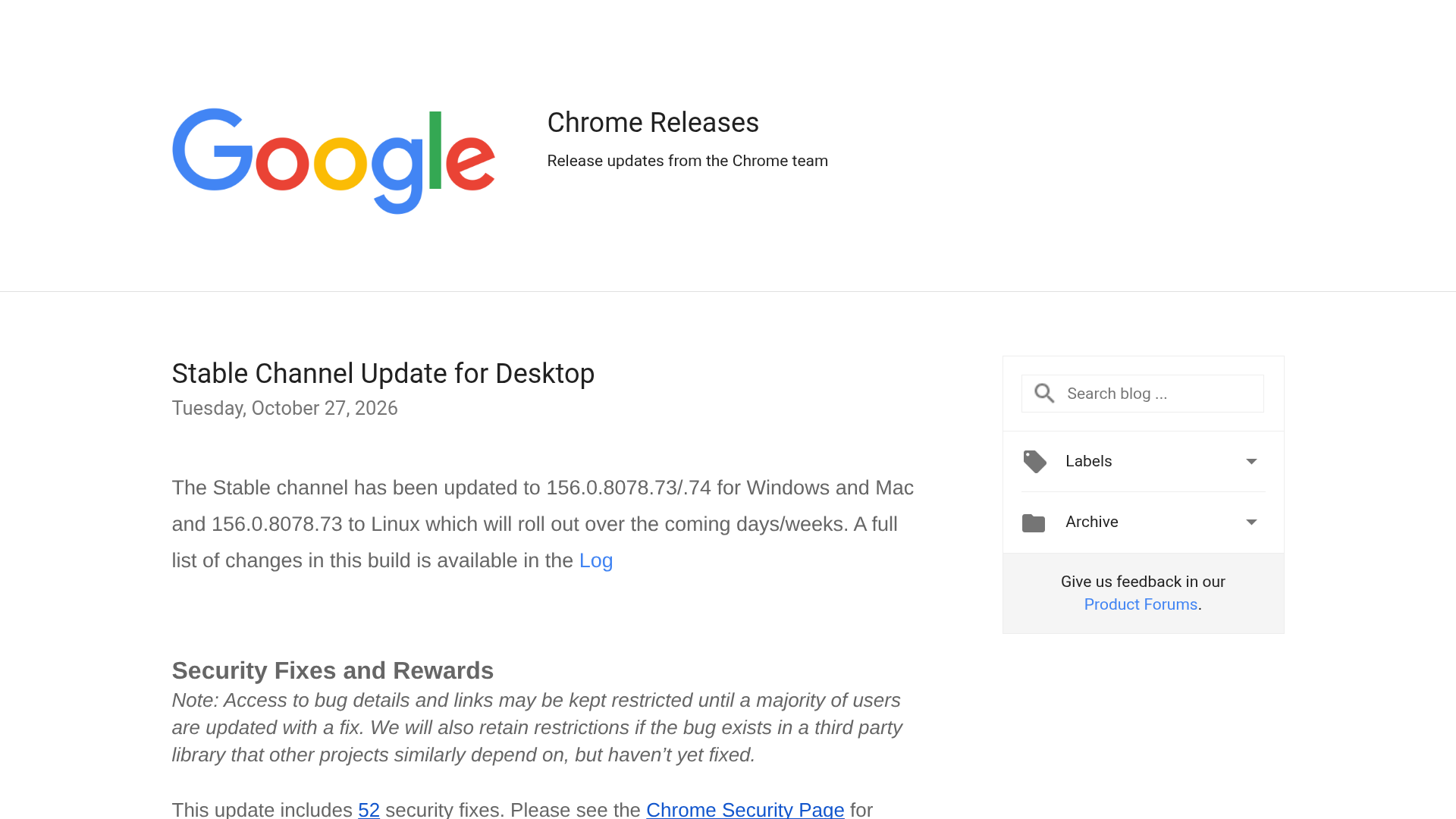
- Chrome: a one-click chain that ran code outside Chrome’s sandbox on macOS, combining a V8 memory bug, a V8 sandbox escape, a CacheStorage race condition and a use-after-free in FedCM. Anthropic says Google assigned 62 CVEs from its reports, “patched as of Chrome 156,” all rated critical or high. Google’s Chrome 156 stable update (156.0.8078.73/.74) credits Anthropic researchers for several of its fixes, including Critical ones.
- Safari: a one-click chain that bypassed the same-origin policy, which could let a web page read data from sites you’re signed in to. Anthropic says Apple’s fix “is available to users.” The post doesn’t name the Safari or iOS version.
- Android: taking photos and other personal data from a locked, stolen Android phone (tested on a Pixel 9) over USB without unlocking it. Anthropic says the issue “has been addressed by Google.” No CVE or bulletin is named.
- Windows: a remote crash of Windows machines that answer HTTP/3 using the built-in implementation. Microsoft tracks it as CVE-2026-33096, an out-of-bounds read in HTTP.sys which Microsoft rates Important (CVSS 7.5), fixed in its April 2026 updates.
- Linux: a zero-click exploit that runs commands as root on servers with a multipath TCP listener, with no login needed. It is CVE-2026-98432, which the Linux kernel’s CVE team rates 9.8 (critical) under CVSS 3.1. It was published October 15, 2026, and is fixed in all maintained stable kernels.
In Anthropic’s proof of concept, the Linux attack took 48 minutes to leak a kernel pointer and about five more minutes to run a command. Failed attempts don’t crash the machine, so an attacker can keep retrying.
Why it matters
Anthropic’s own takeaway is that frontier models can now find and combine several bugs into a working exploit, skills it says “have historically been the domain of few specialist teams.” Expect more bug reports, and faster ones, from both defenders and attackers. Shortening the time between a patch and installing it is the practical response.
The Linux bug is the most serious for small teams. It is reachable over the network and gives root. The kernel’s own CVE record describes it as a use-after-free in IPv4 TCP connection handling present since kernel 4.4. It doesn’t mention multipath TCP, which Anthropic used for its exploit, so we’d patch whether or not you use multipath TCP.
What to do
Steps below are our advice, based on the vendor records.
- Check your Linux kernel. Run
uname -r. Fixed stable versions are 5.10.272, 5.15.223, 6.1.190, 6.6.159, 6.12.113, 6.18.56, 7.2.10, and 7.3 or later. If you use a distro kernel, check your distro’s advisory for CVE-2026-98432, since version numbers differ. Install the update and reboot. - See whether multipath TCP is on, with
sysctl net.mptcp.enabled(1 means enabled). This matches Anthropic’s exploit setup. Our advice: patch either way; turning it off doesn’t replace patching. - Update Chrome to 156 or later and relaunch it. Check under Settings, then About Chrome.
- Install Apple updates on Macs, iPhones and iPads, and Pixel updates on Android phones.
- Patch Windows for CVE-2026-33096, especially servers answering HTTP/3. Microsoft’s fixes include KB5083769 (Windows 11 24H2, build 10.0.26100.8246; 25H2, 10.0.26200.8246), KB5082052 (Windows 11 23H2, 10.0.22631.6936), KB5083768 (Windows 11 26H1, 10.0.28000.1836), KB5082063 (Windows Server 2025, 10.0.26100.32690), KB5082142 (Windows Server 2022, 10.0.20348.5020) and KB5082060 (Windows Server 2022, 23H2 Edition, Server Core, 10.0.25398.2274). ARM64 uses the same KBs. Later cumulative updates also include the fix.
- If you write code, scan it. Anthropic’s advice to defenders: “scanning your own code is more important than ever.”
Sources
| Source | What it confirms | Link |
|---|---|---|
| Anthropic Frontier Red Team (Oct 27, 2026) | Five exploit chains, 62 Chrome CVEs, vendor fixes | https://www.anthropic.com/research/discovering-vulnerabilities-with-claude |
| Linux kernel CVE record | CVE-2026-98432 fixed versions | https://git.kernel.org/pub/scm/linux/security/vulns.git/plain/cve/published/2026/CVE-2026-98432.json |
| NVD CVE-2026-98432 | Published Oct 15, 2026; CVSS 9.8 from the kernel CNA (NVD not yet scored) | https://nvd.nist.gov/vuln/detail/cve-2026-98432 |
| Google Chrome Releases, Stable update 156.0.8078.73/.74 (Oct 27, 2026) | Chrome 156 fixes credited to Anthropic | https://chromereleases.googleblog.com/2026/10/stable-channel-update-for-desktop_0562499947.html |
| Microsoft MSRC CVE-2026-33096 | HTTP.sys DoS, KBs and builds | https://msrc.microsoft.com/update-guide/vulnerability/CVE-2026-33096 |
| NVD CVE-2026-33096 | CVSS 7.5, published Apr 14, 2026 | https://nvd.nist.gov/vuln/detail/cve-2026-33096 |
| CISA KEV (v2026.10.27, 1,760 entries) | Neither CVE listed | https://www.cisa.gov/known-exploited-vulnerabilities-catalog |
Last checked: Oct 28, 2026, 5:57 p.m. Manila (UTC+8). Method: We read Anthropic’s post and checked each CVE against its assigner’s record (Linux kernel CNA, Microsoft), NVD, Google’s Chrome release notes and CISA’s KEV catalog (version 2026.10.27). How we work.
Updates
- Oct 28, 2026, 9:35 p.m. Manila: First published.
Spotted an error? See our corrections policy and tell us.