In this article
TL;DR: At its Universe conference on October 28, 2026, GitHub made two things generally available: Copilot Fusion, which picks and combines models for each task so you don’t choose one yourself, and GitHub Agentic Workflows, which runs coding agents inside GitHub Actions from plain-language Markdown files. It also started including Copilot in GitHub Enterprise for customers with a sales contact, and added team-shared Copilot Automations with AI credit limits. For a small team, the main jobs are to try Fusion on a paid plan while its 30% discount lasts, and to set credit limits on any automation before it runs on its own.
What happened
GitHub published these changes in its changelog on October 28, between 8:30 and 9:00 a.m. US Pacific time (11:30 p.m. to midnight Manila time):
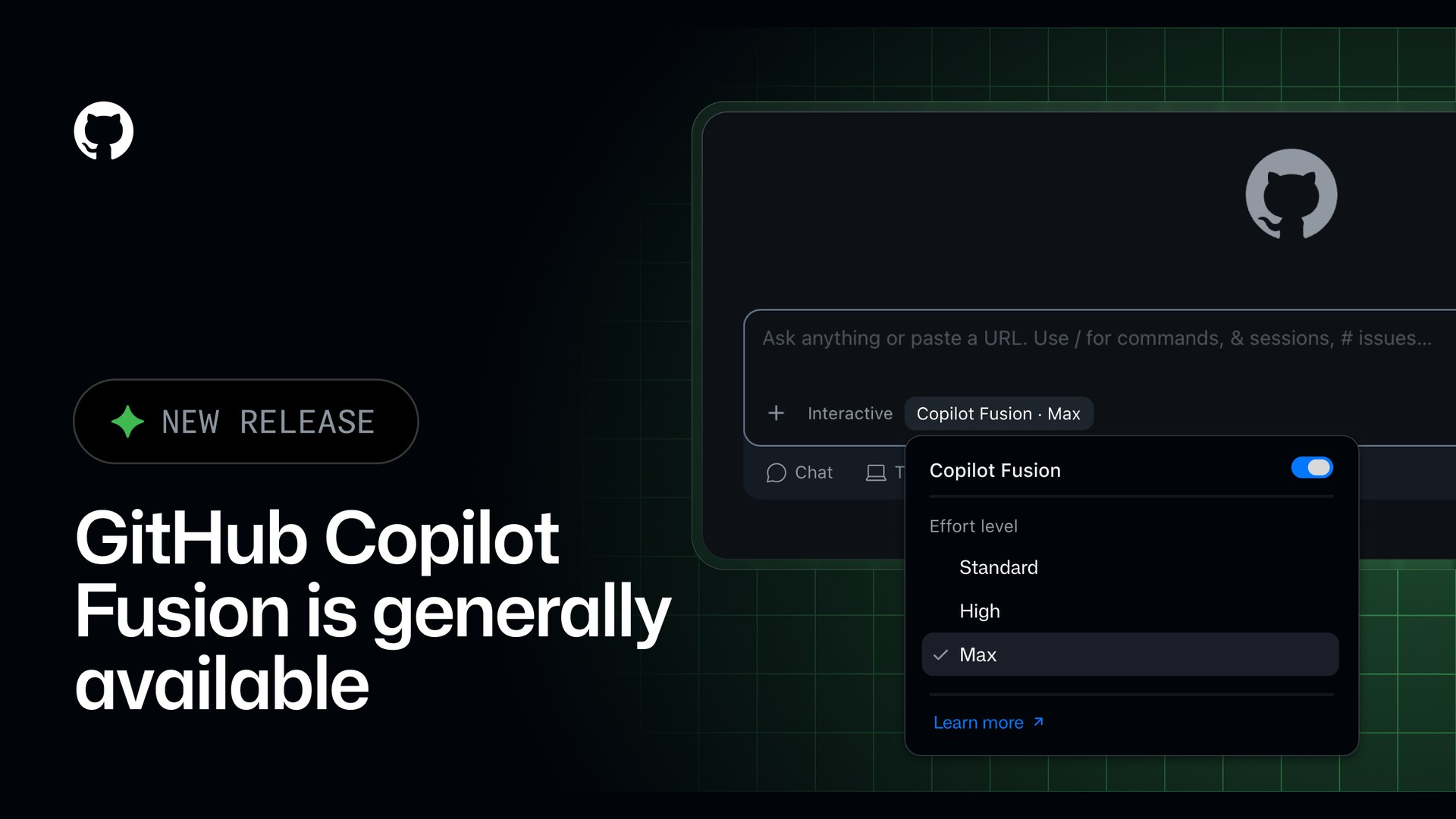
Copilot Fusion is generally available. Instead of choosing a model, you pick Copilot Fusion in the model picker and an effort level: Standard for everyday coding, High for harder tasks or Max for the most demanding ones. For each prompt, Fusion decides which models to use. It may let one model answer, have a cheaper model draft and escalate to a stronger one if a quality check fails, or have a second model review the first one’s work. GitHub says Fusion only uses models allowed by your enterprise and organization model policies, and admins can make it the default. It’s available on all Copilot plans in VS Code, the GitHub Copilot app, Copilot CLI and JetBrains IDEs.
Fusion can route to local models, in an experimental preview. On supported Windows devices, Copilot can download and set up MAI Code 1.1 Flash through Windows ML. In Copilot CLI, you can also point Fusion at MAI Code 1.1 Flash or Qwen3.8 Flash Next running on your own OpenAI-compatible server on Windows, macOS or Linux. GitHub notes that this doesn’t make a session offline, because Fusion still makes its routing decisions in the cloud, and that local models “may have different safety protections” from Copilot’s cloud models.
GitHub Agentic Workflows is generally available. It’s an open source project from GitHub Next. You write a workflow in a Markdown file in plain language, for example to triage issues, analyze CI failures, update docs or write tests, and it compiles to standard Actions YAML that runs on your existing runners. You can power it with Copilot or your own coding agent. By default, agents get read-only permissions and run in a sandboxed container behind GitHub’s Agent Workflow Firewall, and a threat-detection job scans proposed changes before they’re applied. The gh aw forecast command estimates monthly AI credit spend. It’s available on github.com for GitHub Free, Team and Enterprise; using the default Copilot CLI engine needs a Copilot license.
GitHub Enterprise now includes Copilot, for some customers. Enterprises that work with a GitHub or Microsoft account team can get Copilot included for every GitHub Enterprise Cloud user. These seats come with no monthly AI credits: usage is billed against the enterprise budget from the first request. Code completion and next edit suggestions keep working when the budget runs out; Copilot Chat, code review and Copilot in the cloud don’t. Users without a GitHub Enterprise license can get the same access through Copilot Standalone at $10 per user per month. It isn’t open to self-serve customers yet. GitHub says it will open it “in stages” and share dates “in the coming weeks,” and current self-serve subscriptions are unaffected. Copilot Business and Copilot Enterprise remain on sale.
Copilot Automations get shared workflows and cost controls. Automations combine a prompt, a trigger and a set of allowed tools, and run in the cloud. New shared automations belong to a repository, are visible to anyone with read access and editable by anyone with write access, act as Copilot rather than as a person, and bill AI credits to the repository’s owner. An org admin has to turn on the “Allow use of Copilot cloud agent billed to the organization” policy first. GitHub also added a REST API trigger, 24 more GitHub event triggers, chaining between automations, 20 new tools and tools from custom MCP servers. You can now cap AI credits per run, day, week or month; automations without limits keep running as before. Automations are available on Copilot Pro, Pro+, Max, Business and Enterprise, with shared automations still rolling out.
A security extension for the Copilot app, in public preview. It lists a repository’s code scanning alerts in the Copilot app and lets you ask Copilot to explain or fix them. Fixes stay in your local working copy until you push. A /security-review command checks your current changes. Any Copilot plan can install it and run /security-review; seeing existing alerts on private repositories needs GitHub Code Security. GitHub Enterprise Server isn’t supported.
Why it matters
You pay for every model Fusion uses. GitHub says Fusion bills each model it calls at that model’s standard rate, with a 30% discount on model costs “for a limited time” on paid Copilot plans. It hasn’t said when the discount ends. A “Critique” run uses two models on one prompt, so per-prompt costs can rise even if Fusion picks cheaper models most of the time. GitHub’s own claim is that Fusion Max scored 60 on the Artificial Analysis Coding Agent Index, within two points of Claude Code with Opus 5.5 Max, at about half the average API cost per task. That’s GitHub’s figure, not an independent test.
Automations can now spend money without you. An automation fired by the API, a webhook from another tool or another automation can run often and unattended. Shared automations bill the repository owner, not the person who set them up. GitHub’s new per-automation credit limits help, but they’re optional and off unless you set them.
The Enterprise change is for larger customers for now. Small teams buying Copilot Business or Pro themselves see no change today. If you’re on GitHub Enterprise through a sales rep, the new model swaps per-seat credits for one shared budget, so a busy month can stop Chat and code review for everyone once the budget is used up.
What to do now
- Try Fusion Standard on your normal work. Compare a week of usage and output against your usual model while the 30% discount applies. Admins: check your model policy, because Fusion only routes to models you’ve enabled. We covered the models GitHub removed from Copilot earlier this month.
- Cap every automation. Before you turn on a shared or API-triggered automation, set per-run and monthly AI credit limits. Our guide to hard spending limits for AI agents explains how to size them.
- Start Agentic Workflows read-only. Keep the default read-only permissions and the threat-detection job, run
gh aw forecastbefore you schedule a workflow, and begin with low-risk jobs like issue triage or CI failure summaries. - Treat local models as a preview. The routing is experimental, Fusion still makes its routing decisions in the cloud, so the session isn’t offline, and GitHub warns local models may have different safety protections. Don’t count on it to keep work off the network.
- If you’re on Enterprise with a sales rep: ask how the included-Copilot model would affect your budget alerts before you move, since Chat and code review stop when the budget runs out.
Updates
- Oct 29, 2026, 9:05 a.m. Manila: First published.
Sources & method
Sources
- GitHub changelog, “Route and orchestrate models with GitHub Copilot Fusion,” October 28, 2026
- GitHub changelog, “GitHub Copilot Fusion now supports selection of local models,” October 28, 2026
- GitHub changelog, “GitHub Agentic Workflows generally available,” October 28, 2026
- GitHub changelog, “GitHub Enterprise now includes access to GitHub Copilot,” October 28, 2026
- GitHub changelog, “Build shared workflows for your team with Copilot Automations,” October 28, 2026
- GitHub changelog, “New tools, triggers, and cost controls for Copilot Automations,” October 28, 2026
- GitHub changelog, “Security extension for the GitHub Copilot app,” October 28, 2026
Method. Last checked October 29, 2026, at 7:00 a.m. Manila time (23:00 UTC on October 28). Every feature, plan, price and availability detail comes from GitHub’s October 28 changelog posts; the Fusion benchmark and cost figures are GitHub’s own claims. The image is GitHub’s Copilot Fusion release image with flat dark bands added above and below to fit our 16:9 frame; nothing was cropped. The analysis and the steps under “What to do now” are our own; we haven’t tested these features. No affiliate links on this page. How we work.
Spotted an error? See our corrections policy and tell us.