In this article
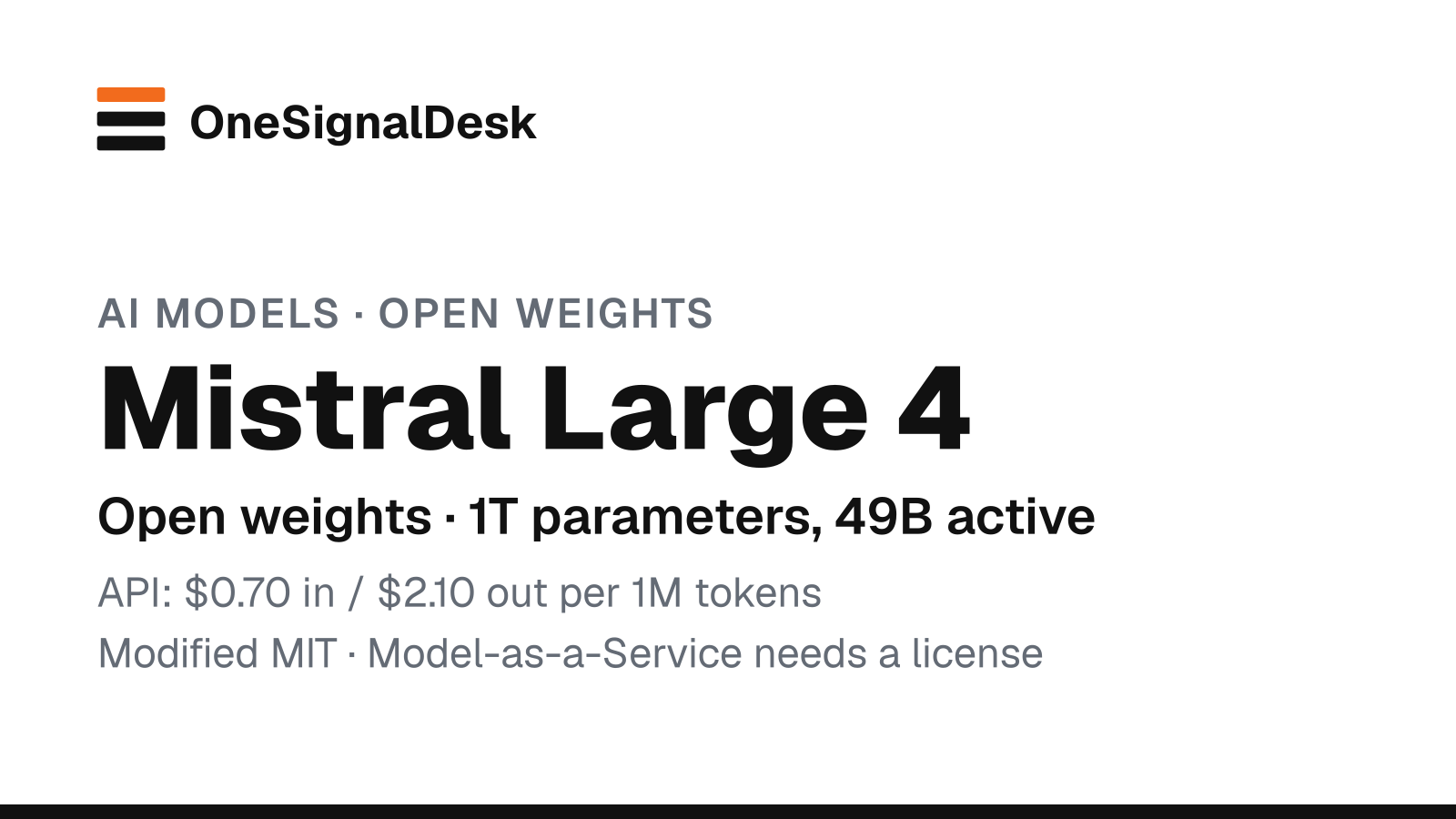
TL;DR: Mistral has released the weights of Mistral Large 4, its 1-trillion-parameter model, on Hugging Face, three weeks after an API-only preview. The license is free for commercial use, with one catch: a company that runs a Model-as-a-Service business (giving others API or hosted access with meaningful control over inputs, parameters or training data) needs a separate commercial license from Mistral before using the model commercially. Mistral’s API price is $0.70 per million input tokens and $2.10 per million output tokens. If your code uses the old “None” reasoning mode, switch it to the new “Low” mode.
What happened
On October 29, 2026, at 12:00 UTC (8:00 p.m. Manila), Mistral published “Mistral Large 4 (Le Chonk) is now open weight.” The model went into public preview on October 6 with the promise that weights would follow at the end of the month.
According to Mistral’s announcement and the Hugging Face model card:
- Size. A mixture-of-experts model with 1 trillion parameters in total and 49 billion active per token (52 billion counting embeddings and output layers), with a 1 million token context window. It takes text and image input.
- What’s new since the preview. Mistral says three more weeks of reinforcement learning improved coding and defensive security work, and that the model now uses fewer tokens for the same tasks. On Terminal-Bench 4.0 it says the score rose 13 points to 41% while output tokens fell 30%.
- Three reasoning modes. Low, Medium and High (the default). Mistral says Low “replaces ‘None’ reasoning mode.” In the model card’s code examples, this is the
reasoning_effortsetting. - Benchmarks. Mistral says it’s the best open-weight model for coding, citing Cognition’s FrontierCode 2.0 (19.7%) and the Artificial Analysis Coding Agent Index (48%, tied with GLM-5.3 on 47% fewer tokens per task). These are Mistral’s figures; independent results aren’t out yet, and the technical report is “coming soon.”
- Where to get it. Mistral Studio, the Mistral API, OpenRouter, Microsoft Foundry, NVIDIA-hosted endpoints and NIM, or the weights on Hugging Face to run with vLLM or SGLang. A quantized NVFP4 checkpoint of the same model, with a smaller memory footprint, targets NVIDIA Blackwell GPUs.
Why it matters
For builders, the license is the headline. Under the Mistral Ecosystem Open-Weight License, a modified MIT license, you can use, modify, fine-tune and sell products built on the model. The one condition, in Mistral’s words: “businesses that operate a Model-as-a-Service offering must obtain a separate commercial license from Mistral before using the model commercially.” Our read: under the LICENSE, internal use and end-user products that embed the model in specific features don’t need a commercial license; giving third parties API or hosted access with meaningful control over inputs, parameters or training data counts as Model as a Service and does.
The model card’s serving examples run on a node of 8 GPUs. Our read: that puts self-hosting a 1-trillion-parameter model out of reach for most small teams, and for most the practical route is the API at $0.70 in and $2.10 out per million tokens. If you already use another low-cost model API, such as DeepSeek V4.1 Flash, compare cost per finished task before you switch. Our read: open weights matter more to firms with data-residency rules, which can run it in their own cloud or on-premises.
Mistral also says it saw “a potential for uplift to conduct real attacks” in live traffic and is tightening its guardrails. Our read: expect the hosted model’s behavior on security tasks to keep changing.
What to do now
- Fix old reasoning settings. If your code or agent config sets reasoning to “None,” change it to
reasoning_effort="low". Use “medium” for everyday tasks and “high” for hard agent runs, as the model card advises. - Test it on your own tasks. Run a few of your real coding or document jobs through the API or OpenRouter before you trust Mistral’s benchmark claims.
- Read the license before you offer the model to others. If you give customers API or hosted access to the model with meaningful control over inputs, parameters or training data, the license calls that Model as a Service and you need Mistral’s commercial license. Internal use and features embedded in your own product don’t, per the LICENSE.
- Our tip: compare token use, not just price. Mistral’s main claim is fewer tokens per task, and that’s what decides your bill.
Mistral’s earlier open release this month was Timestral, its forecasting models that run on a CPU.
Updates
- Oct 30, 2026, 4:30 p.m. Manila: First published.
Sources & method
Sources
- Mistral AI, “Mistral Large 4 (Le Chonk) is now open weight” (Oct 29, 2026)
- Mistral AI, “Introducing Mistral Large 4” (preview, Oct 6, 2026)
- Hugging Face, Mistral-Large-4-1T-A52B model card
- Hugging Face, Mistral-Large-4-1T-A52B-NVFP4
- Mistral Ecosystem Open-Weight License
Method. Last checked October 30, 2026, at 1:00 p.m. Manila (UTC+8). Specs, prices, license terms and quotes come from Mistral’s announcement and model card. Benchmark figures are Mistral’s own; we haven’t tested the model. Tips marked “Our tip” and analysis marked “Our read” are ours. No affiliate links on this page. How we work.
Spotted an error? See our corrections policy and tell us.